The Problem with Greenwashing
The market for eco-friendly tableware has grown dramatically over the past five years — and with it, so has the number of products making environmental claims that do not hold up to scrutiny. Terms like 'biodegradable', 'compostable', 'natural', and 'sustainable' appear on packaging and product listings without any independent verification. Buyers — whether they are event planners, restaurant owners, retail buyers, or wholesale importers — are increasingly unable to distinguish genuine sustainability from marketing.
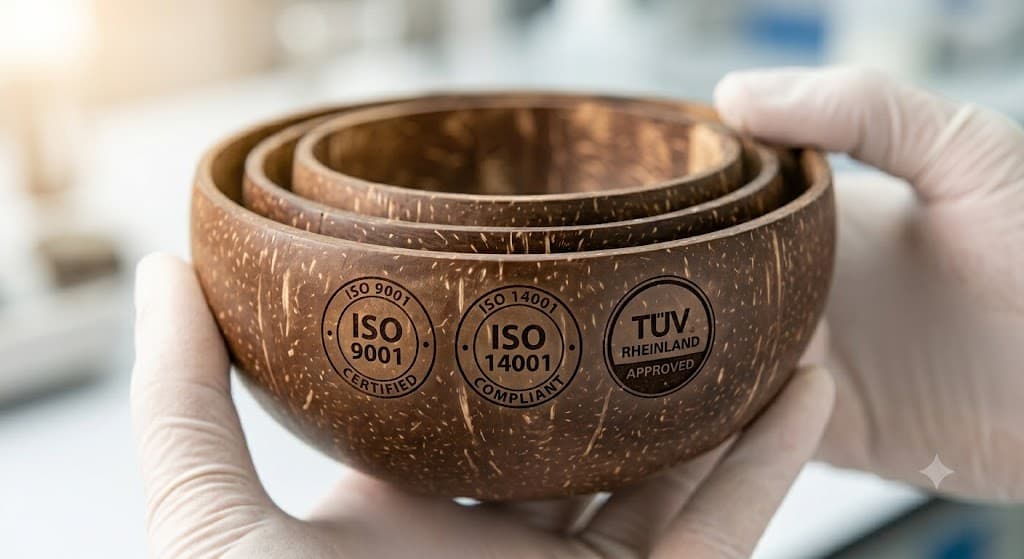
This is where certifications matter. Independent, third-party certifications from recognised bodies are the only reliable way to verify that a product and its manufacturer meet the environmental and quality standards being claimed. For eco-friendly tableware, three certifications stand above the rest: ISO 9001, ISO 14001, and TÜV Rheinland.
ISO 9001:2015 — Quality Management
ISO 9001 is the internationally recognised standard for Quality Management Systems. Certification means a manufacturer has demonstrated consistent processes, documented procedures, and systematic quality control — from raw material intake through to finished product dispatch.
For tableware buyers, ISO 9001 certification answers a fundamental question: will every batch be as good as the samples? Inconsistency is one of the most common pain points when sourcing from manufacturers in emerging markets. A certified quality management system means that production standards are not dependent on one skilled worker or one good production run — they are built into the process.
ISO 9001 covers customer focus, leadership accountability, process approach, and continuous improvement. It is audited and renewed regularly by accredited external bodies, meaning the certification reflects current practice, not a one-time achievement.
ISO 14001:2015 — Environmental Management
ISO 14001 is the international standard for Environmental Management Systems. It requires a manufacturer to demonstrate that they actively identify, monitor, and reduce the environmental impact of their operations — not just in their products, but across their entire facility and supply chain.
For buyers sourcing eco-friendly tableware, ISO 14001 provides crucial assurance. It is not enough for a product to be made from a natural material; the manufacturing process itself must be managed responsibly. Water usage, energy consumption, waste disposal, emissions, and supply chain sourcing are all within scope of an ISO 14001 audit.
Certification means an independent auditor has reviewed and approved the manufacturer's environmental practices — and that those practices are subject to ongoing monitoring and improvement. For buyers making sustainability commitments to their own stakeholders, ISO 14001 certification from a supplier is meaningful, verifiable evidence.
TÜV Rheinland — Precision Testing and Product Safety
TÜV Rheinland is one of the world's most respected independent testing and certification organisations, headquartered in Germany. Their motto — 'Precisely right' — reflects an approach to certification that goes beyond process audits to include rigorous product testing.
TÜV Rheinland certification is particularly significant for tableware because it covers product safety and performance in real use conditions: material composition, chemical safety, food-contact compliance, and structural integrity. For palm leaf tableware, coconut shell products, and reed straws, TÜV Rheinland approval provides assurance that the product is what it claims to be — natural, chemical-free, and safe for food contact.
For importers supplying European, North American, or Australian markets, TÜV Rheinland certification is frequently required by retail buyers, certification bodies, and regulatory frameworks. It is a globally recognised mark of product integrity.
What to Look for When Sourcing Sustainable Tableware
For buyers evaluating eco-friendly tableware suppliers, certifications are the starting point, but not the only consideration.
- Ask for certificate copies and verify their current validity — certifications expire and must be renewed.
- Check which specific scope is covered — an ISO 9001 certificate for one product line does not cover all products in a range.
- Request product test reports alongside certificates — performance claims (compostability timelines, heat resistance, food safety) should be backed by documented test data.
- Look for transparency about the supply chain — where are raw materials sourced, who collects the leaf sheaths, and what are the working conditions in the facility?
- Consider the manufacturer's track record — how long have they been operating, and do they have documented export history to regulated markets?
Sasi International: Certified Since 2008
Sasi International has been manufacturing and exporting premium eco-friendly tableware from Coimbatore, Tamil Nadu, India since 2008. Our facility holds ISO 9001:2015 (Quality Management) and ISO 14001:2015 (Environmental Management) certifications, and our products carry TÜV Rheinland approval.
These certifications are not marketing assets — they are the backbone of how we operate. Every batch of palm leaf plates, coconut shell bowls, and reed straws that leaves our facility has been produced under documented quality and environmental management systems, reviewed by independent auditors, and tested to internationally recognised safety standards.
When you source from Sasi International, you are not simply buying a product. You are sourcing from a verified, transparent, accountable manufacturer — one whose environmental and quality claims can be independently confirmed.