Where Every Coconut Bowl Begins: The Grove
Before a coconut bowl reaches your kitchen, it begins its journey in a tropical grove — in places like Vietnam, Sri Lanka, Indonesia, or South India, where coconut palms are part of the agricultural fabric of daily life. Millions of coconuts are harvested each year for their water and flesh, which are used in food and beverage production. The shells that remain after processing are, in most cases, discarded or burned as agricultural waste.
That is where the coconut bowl's story truly starts — not with a tree being cut down, but with a shell that would otherwise go to waste.
Upcycling Agricultural Waste into Artisan Kitchenware
A coconut shell is a remarkably durable material. Dense, naturally food-safe when polished correctly, and smooth when sanded, it is ideally suited to become a bowl. What it requires is skilled hands and a commitment to craft.
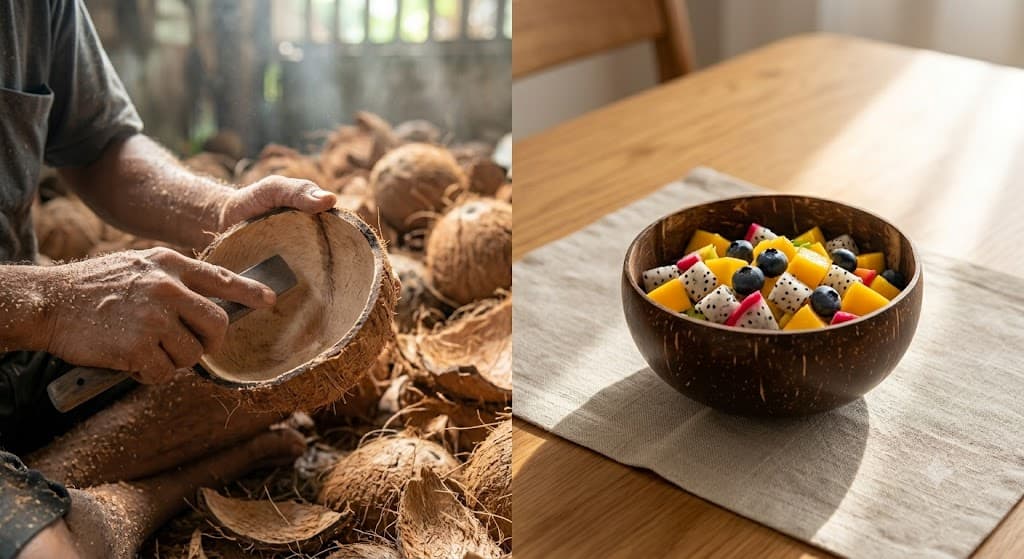
After the coconut flesh and water are extracted, the shell is cleaned thoroughly, inspected for cracks, and passed to artisans who shape, sand, and polish each piece by hand. No two coconut shells are identical in size, shape, or grain — which means every coconut shell bowl is genuinely unique.
The Making Process: Step by Step
- Shell selection: Raw coconut shells are sorted for structural integrity. A traditional 'tap test' — listening for a clear, resonant ring — reveals whether the shell is solid and crack-free.
- Shaping and sanding: Each shell is progressively sanded through multiple grits to create a smooth interior and exterior surface, removing fibrous husk residue while preserving the natural grain.
- Polishing with coconut oil: The shell is hand-rubbed with organic virgin coconut oil — and nothing else. This natural polish penetrates the fibres, enhances the wood's depth of colour, and creates a food-safe surface entirely free from synthetic lacquers, BPA, or chemical sealants.
- Quality inspection: Each finished bowl is checked for smoothness, stability, and finish before packaging.
Food Safety: What Makes a Coconut Bowl Safe to Eat From?
Quality handcrafted coconut bowls are polished exclusively with food-grade coconut oil — making them completely free from chemicals, BPA, and toxins. This finish is what gives the bowl its warm lustre and keeps the natural fibres sealed against moisture during normal use.
Coconut bowls are best suited to room-temperature or slightly warm foods — ideal for smoothie bowls, fruit, grains, oatmeal, salads, and snacks. They should be hand-washed with lukewarm water and re-oiled occasionally with coconut oil to maintain their finish and longevity.
The Zero-Waste Credentials
A coconut bowl earns its place in the sustainable kitchen on multiple counts. First, it upcycles what would otherwise be agricultural waste — giving a second life to a material that would typically be incinerated or landfilled. Second, it is made without synthetic additives, meaning it is fully biodegradable at the end of its life. Third, because it is reusable — properly cared for, a coconut shell bowl can last for years — it eliminates the need for disposable alternatives entirely.
Why Coconut Bowls Have Found Their Moment
The rise of the coconut bowl is tied to broader cultural shifts: a growing interest in plant-based eating, conscious consumption, and the aesthetic of natural materials in the home. For consumers who want their kitchenware to reflect their values — products that are beautiful, natural, ethically made, and genuinely sustainable — the coconut shell bowl offers something that mass-produced plastic or ceramic simply cannot: a direct, tangible connection to craft and to nature.
From Grove to Table
The journey of a coconut bowl is one of transformation — from overlooked agricultural by-product to considered, handcrafted object. It passes through the hands of farmers, artisans, and craftspeople before arriving in yours. In a world producing enormous quantities of waste, the coconut bowl is a small but meaningful counterpoint: a reminder that thoughtful design and skilled craft can find beauty, utility, and sustainability in the things we would otherwise throw away.