Why India Is the Global Source for Palm Leaf Tableware
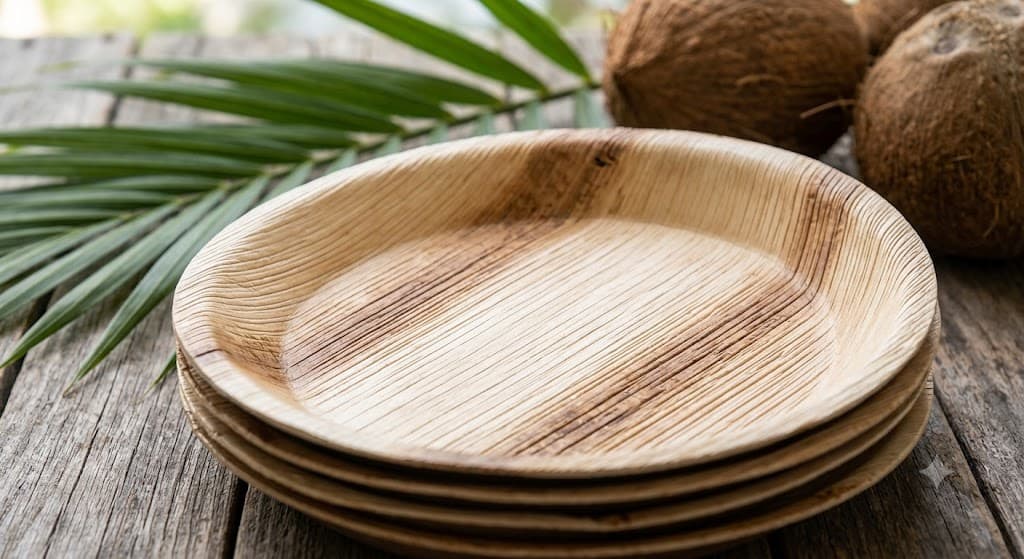
India accounts for approximately 60% of global areca palm cultivation, making it the world's dominant source of raw material for palm leaf tableware. The areca palm (Areca catechu) thrives across the southern states of Tamil Nadu, Karnataka, Kerala, and Andhra Pradesh — and it is from these regions that the naturally fallen leaf sheaths used for palm leaf plates, bowls, trays, and serveware are collected.
The concentration of raw material, manufacturing expertise, and export infrastructure in South India means that buyers worldwide — from European importers to US distributors to hospitality chains in the Middle East and Australia — consistently source their palm leaf tableware from India. In the 12 months to mid-2025, India exported over 420 metric tons of areca leaf plates to the US market alone, across approximately 44 shipments. The areca leaf plates market globally was valued at USD 100 million in 2026 and is growing steadily.
For wholesale buyers evaluating India as a sourcing destination, the question is not whether to source from India — it is how to identify the right manufacturer and structure a supply relationship that delivers consistent quality, reliable lead times, and full regulatory compliance.
Step 1: Define Your Product Requirements Before You Approach Suppliers
The range of palm leaf tableware available from Indian manufacturers is broad: plates in round, square, oval, and hexagonal formats; bowls in multiple depths; divided portion plates; sushi trays; mini serveware for condiments and dips; serving trays in ellipse, rectangle, and hexagonal shapes. Before contacting manufacturers, buyers should have a clear brief covering:
- Product categories and shapes required
- Size specifications — diameter, depth, and rim profile
- Estimated annual volume and order frequency
- Packaging requirements — bulk, retail-ready, or private label
- Target markets and any regulatory compliance requirements (EU, US FDA, UK, Australia, UAE)
- Sample requirements and timeline for a first order
Arriving at conversations with clear requirements signals to manufacturers that you are a serious buyer and allows them to provide accurate quotations rather than broad estimates.
Step 2: Evaluate Manufacturers on Certifications, Not Price Alone
In the palm leaf tableware category, price variation between suppliers is often a reflection of quality control rigour, certification investment, and manufacturing standards — not simply cost efficiency. Buyers who select on price alone frequently encounter inconsistency in product dimensions, moisture content variation that affects shelf life, and inadequate documentation for import compliance.
The certifications that matter most for international wholesale buyers are:
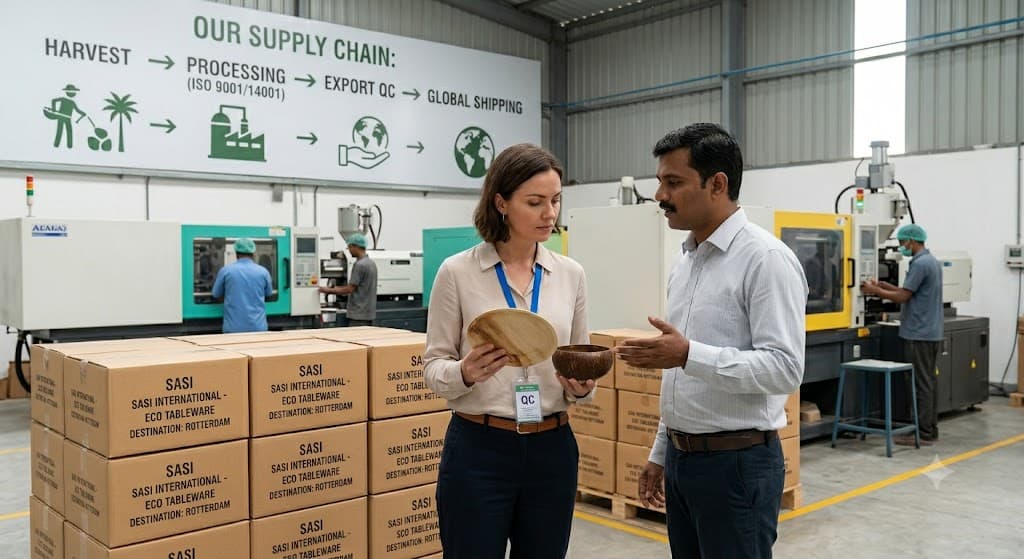
- ISO 9001:2015 (Quality Management): Confirms documented, audited quality control systems across the production process.
- ISO 14001:2015 (Environmental Management): Confirms that the manufacturer actively monitors and reduces the environmental impact of operations.
- TÜV Rheinland or equivalent third-party product testing: Confirms food safety, chemical-free manufacturing, and structural integrity through independent product-level testing.
- Compostability certifications (CMA, OK Compost Home, EN13432): Required for products sold into regulated markets in the EU and parts of the US.
Request copies of all certificates and verify their current validity dates. Reputable manufacturers renew certifications regularly and share documentation readily.
Step 3: Understand Lead Times and Seasonal Raw Material Availability
One factor that catches first-time importers off guard is the seasonal availability of areca palm leaf raw material. Fallen leaf sheaths are collected predominantly between November and April, when the natural leaf-drop cycle peaks. Manufacturers with strong procurement relationships and storage infrastructure can supply year-round — but buyers placing large orders outside this window should confirm raw material availability explicitly.
Typical lead times from a confirmed order to container loading range from 3 to 6 weeks for standard products, depending on volume and complexity. Custom shapes or sizes that require new mould fabrication will add 2 to 4 weeks. For buyers with seasonal peaks — wedding season, summer events, holiday retail — it is essential to plan procurement 8 to 12 weeks ahead to allow for production, quality inspection, container loading, and transit time.
Step 4: Clarify Minimum Order Quantities and Shipping Options
Minimum order quantities (MOQs) vary significantly between manufacturers. Small-batch suppliers may accept orders from a few hundred units per SKU; export-focused manufacturers typically work with full container loads (FCL — 20ft or 40ft) or less-than-container loads (LCL) for smaller initial orders.
For buyers new to a supplier, an LCL order of mixed products is a prudent first step — it allows product and quality verification before committing to full container volumes. Established relationships typically move to FCL ordering, which significantly reduces per-unit shipping costs.
Confirm the following with any prospective supplier before placing an order:
- MOQ per SKU and across the full order
- LCL vs FCL options and any cost differential
- Packaging specifications and carton counts
- Whether pre-shipment third-party inspection is supported
- Payment terms — T/T advance, letter of credit, or milestone-based payment structures
Step 5: Request Samples and Run a Small Trial Order
No wholesale relationship should begin without physical samples. Request samples of every SKU you intend to order — not photographs, but physical products shipped to your location. Evaluate them for dimensional consistency, surface finish, natural grain uniformity, absence of cracks or splits, moisture content (dry to the touch with no musty odour), and structural integrity under meal conditions.
After sample approval, a trial LCL order allows verification that production-batch quality matches samples. This is a standard part of responsible procurement from any new supplier and should not be presented as distrust — reputable manufacturers expect and welcome this process.
Why Sasi International
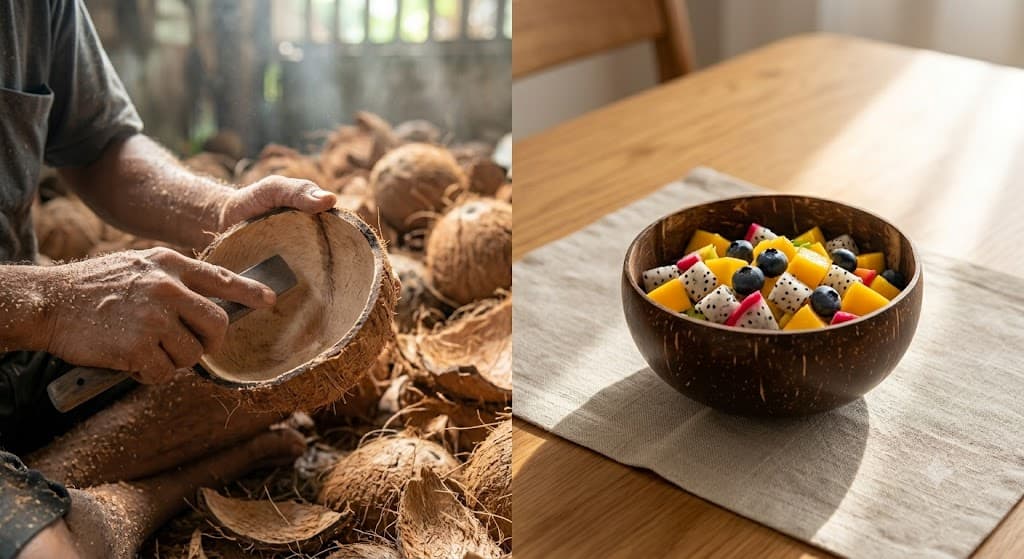
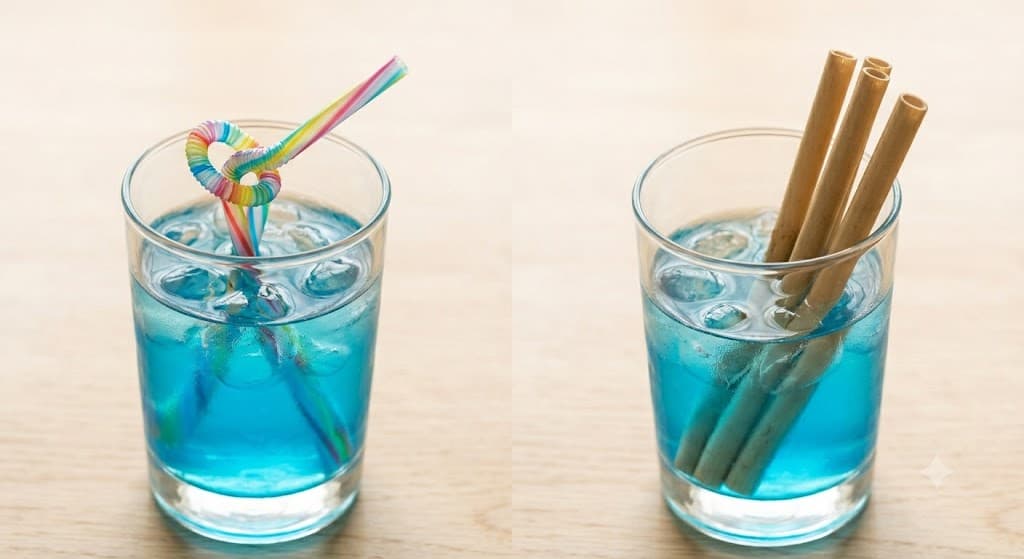
Sasi International has been manufacturing and exporting premium areca palm leaf tableware, coconut shell products, and reed straws from Coimbatore, Tamil Nadu since 2008. ISO 9001:2015 and ISO 14001:2015 certified, TÜV Rheinland approved, and with a product range spanning over 40 shapes and sizes across multiple collections, we supply wholesale buyers across Europe, North America, the Middle East, and Asia-Pacific.
We welcome enquiries from distributors, importers, retail buyers, and hospitality procurement teams. For product catalogues, samples, pricing, and lead time discussion, contact us at info@contact.sasiintlindia.com or via WhatsApp at +91 95730 70838.