Why Due Diligence Matters More in the Eco Category
The market for eco-friendly tableware has expanded rapidly — and with that expansion has come a significant increase in the number of suppliers making sustainability claims that do not hold up to scrutiny. Greenwashing is a documented problem in the category: products described as compostable that require industrial composting infrastructure not available to most buyers; plates described as chemical-free that have been treated with synthetic coatings; manufacturers claiming certifications that are expired or not applicable to the products being ordered.
For wholesale buyers, importers, and procurement managers, the cost of getting this wrong is not just financial. Non-compliant products can create regulatory exposure in regulated markets, damage relationships with retail customers who have their own sustainability commitments, and — in the worst cases — result in product recalls.
The checklist below is designed to give wholesale buyers a structured framework for evaluating eco tableware suppliers before committing to an order. Use it with every new supplier, regardless of how convincing their initial presentation may be.
The 10-Question Due Diligence Checklist
1. Are your ISO certifications current, and can you provide copies?
Ask for ISO 9001 (Quality Management) and ISO 14001 (Environmental Management) certificates and verify the issue date, scope, and expiry. Certificates more than three years old without a renewal date should prompt further questioning. The scope of the certificate should cover the specific products you intend to order.
2. What third-party product testing has been carried out, and by whom?
Process certifications (ISO) confirm how a manufacturer operates; product certifications confirm what the product actually is. Ask for TÜV Rheinland, SGS, or equivalent third-party test reports covering food safety, chemical composition, and compostability performance for the specific SKUs you are ordering.
3. Are your products certified compostable — home or industrial?
'Biodegradable' and 'compostable' are not interchangeable. Compostable products must meet specific standards (EN13432 for the EU, ASTM D6400 for the US, OK Compost Home for backyard composting). Ask which standard applies, obtain the certificate, and verify it covers the products in your order — not just the manufacturer's facility in general.
4. What chemicals, coatings, or additives are used in production?
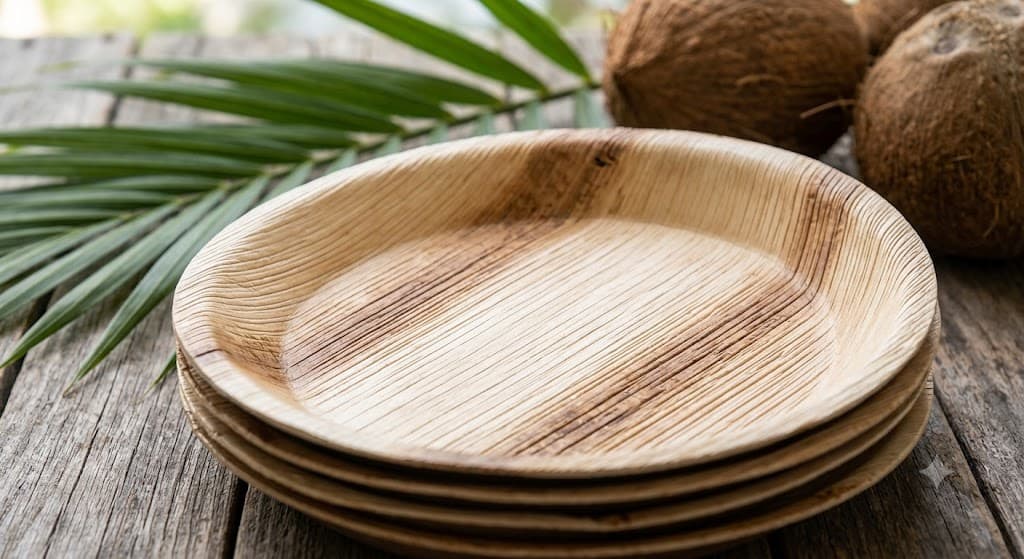
The answer for genuine palm leaf tableware should be: none. The manufacturing process uses only water, heat, and pressure. Any mention of waxes, binders, bleaches, dyes, or synthetic coatings should prompt a request for full material disclosure and food-safety test reports.
5. Where is your raw material sourced, and how is its availability managed across seasons?
Areca palm leaf sheaths are collected seasonally, primarily between November and April. Ask how the manufacturer manages raw material procurement and storage to ensure year-round supply consistency. Manufacturers without a clear answer to this question are more likely to experience supply disruptions on large orders.
6. What are your minimum order quantities, and what options exist for trial orders?
Understand the MOQ structure clearly — per SKU, per product category, and total order. Ask whether LCL (less-than-container load) options are available for first orders. A manufacturer that does not accommodate trial orders is a higher-risk sourcing relationship.
7. What is the standard lead time from order confirmation to container loading?
Get this in writing, with clarity on what could affect the timeline — custom shapes requiring new moulds, seasonal raw material constraints, peak production periods. Build buffer into your procurement calendar based on the answer, plus transit time to your destination.
8. Do you support pre-shipment third-party inspection?
For large or high-value orders, pre-shipment inspection by an independent third party (SGS, Bureau Veritas, Intertek) is standard practice. A reputable manufacturer will confirm they support this process. The cost is typically borne by the buyer, but the risk mitigation is substantial.
9. What documentation do you provide for import compliance?
Depending on your target market, you may need a Certificate of Origin, phytosanitary certificate, food safety declarations, compostability certificates, and material safety data. Ask for a complete list of documentation the manufacturer provides as standard, and confirm it covers what your customs broker and regulatory environment require.
10. Can you provide references from current wholesale buyers in my target market?
A manufacturer with a track record of supplying regulated markets (EU, UK, US, Australia) will have reference buyers in those markets. Ask for introductions or contact details. A manufacturer who cannot provide references from comparable buyers is a higher-risk supplier, regardless of how professional their catalogue appears.
What Good Answers Look Like
A reliable, export-ready eco tableware manufacturer will have clear, documented answers to every question above — and will share documentation readily. Hesitation on certifications, vagueness about raw material sourcing, or reluctance to support pre-shipment inspection are all meaningful signals.
The best sourcing relationships in this category are built on transparency. Manufacturers who are confident in their processes and products welcome scrutiny — because it distinguishes them from the commodity suppliers who cannot provide the same assurances.
Sasi International: Transparent by Design
At Sasi International, we have been supplying wholesale buyers and international importers since 2008. We are ISO 9001:2015 and ISO 14001:2015 certified, TÜV Rheinland approved, and our manufacturing processes use no chemicals, dyes, or synthetic additives at any stage.
We provide full documentation for import compliance, support pre-shipment inspection, offer LCL options for trial orders, and welcome reference requests from prospective buyers. If you are evaluating eco tableware suppliers and want to put us to the test with this checklist, we invite you to. Contact us at info@contact.sasiintlindia.com or via WhatsApp at +91 95730 70838.